The Old Slave Market & Anglican Cathedral, Stone Town
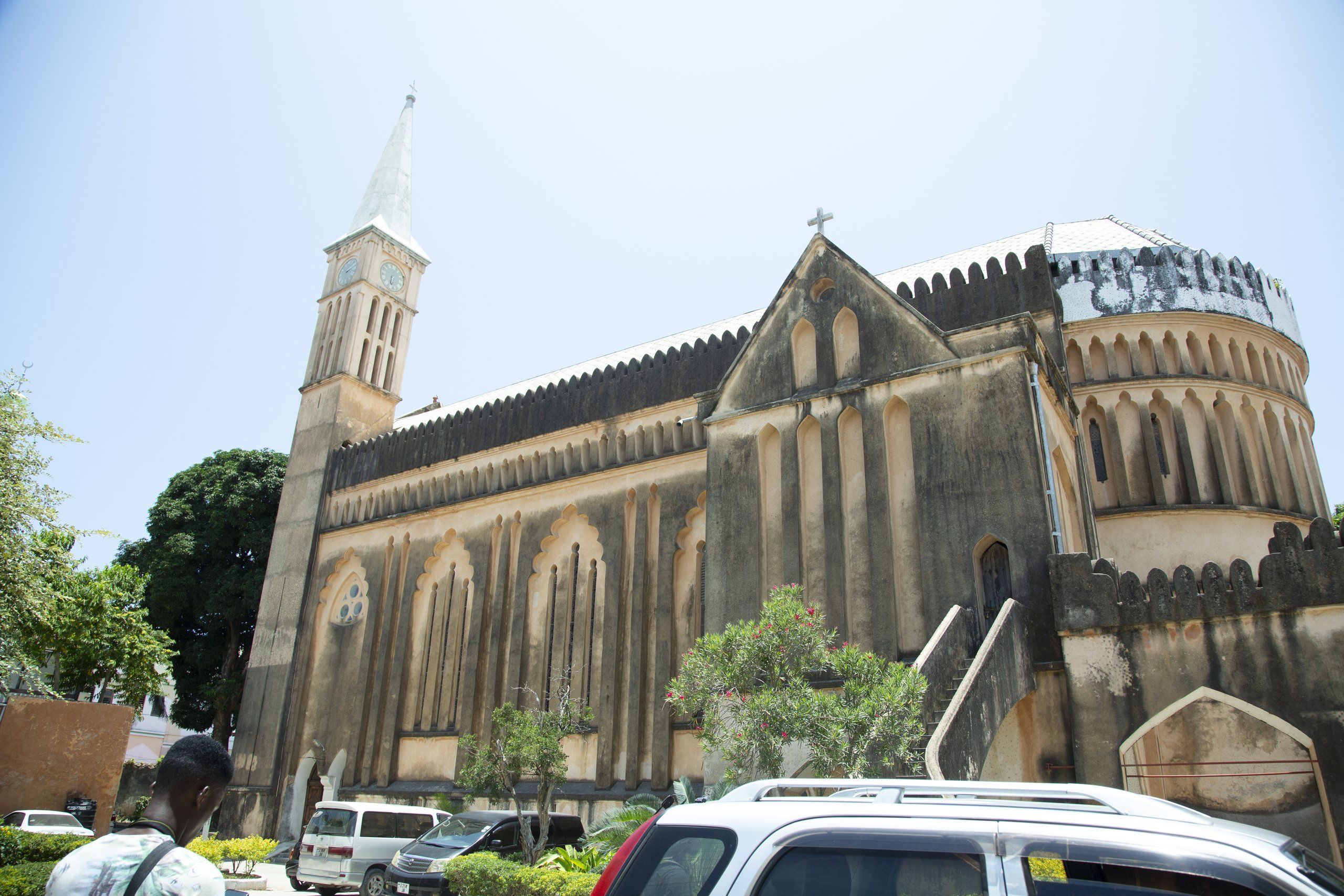
The Old Slave Market in Stone Town stands on the site of East Africa's largest 19th-century slave market. The Anglican Christ Church Cathedral was built over it to mark the trade's end. You can visit the cathedral, a memorial sculpture, an exhibit on the slave trade and the underground holding cells. Entry is about US$5 per adult (2026, verify); allow about an hour. A sobering, essential visit.
The Old Slave Market and Anglican Cathedral in Stone Town stand on the ground where East Africa’s largest slave market once operated. The cathedral was built to mark the end of the trade, and the memorial, the exhibit and the surviving holding cells make this a sobering but essential visit, not a light one.
Set your expectations before you arrive. This is a place of memory, not a photo stop. An hour here, with or without a guide, is one of the most important things you can do in Zanzibar, and it is meant to be uncomfortable.
What happened on this site
In the 19th century, Zanzibar was the commercial centre of the East African slave trade. Under the Omani sultans, enslaved people were captured or bought far inland, marched in caravans to the coast, shipped to the island, and sold in the open-air market that stood here in the Mkunazini quarter. From this market they were sent on to Arabia, Persia, the islands of the Indian Ocean, and to the clove plantations of Zanzibar and Pemba. Some were held offshore before sale: in the 1860s, the island now known as Prison Island (Changuu) was used to detain captives before they were brought here to the market. The two sites are two ends of the same trade.
By some estimates, tens of thousands of people passed through Zanzibar’s market each year at the height of the trade. Buyers inspected them as goods. It was one of the last large slave markets to operate openly anywhere in the world.
The market closed in 1873, when Sultan Barghash, under sustained British pressure, signed a treaty ending the export slave trade and shutting the market itself. Slavery within Zanzibar was not fully abolished for years afterwards, but shutting this market ended the open buying and selling of people in the town.
The cathedral built over the market
Weeks after the market closed, the Anglican mission began building a cathedral on the very ground where people had been bought and sold. Christ Church Cathedral was the work of the Universal Mission to Central Africa, led by Bishop Edward Steere, and the choice of site was deliberate: a church of the abolitionists raised over the market it had campaigned to end. The foundation stone was laid on Christmas Day in 1873, and the building was completed in 1879.
Inside, the altar is said to stand on the spot of the market’s whipping post, where captives were flogged so buyers could judge their endurance, and a marble circle set into the floor is pointed out as the place. The interior is plain and moving rather than grand. It remains a working cathedral, so services still fill it on Sundays, which is worth knowing if you are hoping for a quiet look around.
The people who ended it
The market did not close on its own. Its end came after decades of pressure: British naval patrols intercepting slave dhows at sea, and campaigners whose accounts hardened public opinion against the trade. The explorer and missionary David Livingstone was among the loudest of them, and his reports of the caravans he saw in the interior reached a wide audience in Britain. Livingstone died in the African interior in 1873, the same year the market closed. His body was carried to the coast and eventually to London, and a crucifix in the cathedral is said to be carved from the wood of the tree under which his heart was buried.
The mission that built the cathedral did more than raise a building. It settled freed men, women and children in villages such as Mbweni, just outside Stone Town, giving people released from the trade land, schooling and a place to rebuild their lives. The exhibit follows these threads alongside the harder ones, so you come away with the abolition story as well as the horror that made it necessary.
The holding cells and the memorial
The hardest part of a visit is below ground. In the former mission buildings beside the cathedral are the cramped chambers where captives were confined before sale, low-ceilinged stone rooms with little light and almost no air, into which dozens of people were forced at a time. You can step inside one. A minute standing in that space, imagining it packed with the sick and the frightened, is the part most visitors carry home.
In the courtyard outside is the memorial “Memory for the Slaves,” created by the sculptor Clara Sörnäs in 1998: stone figures standing in a sunken pit, heads bowed, bound together with original iron slave chains. Nearby, the East Africa Slave Trade Exhibit, run by the Anglican Diocese, traces the trade and the long campaign to end it through photographs, documents and the stories of the people caught up in it, including the freed-slave communities the mission helped to build. Read it slowly. It is what turns the plain rooms into a history you understand.
Visiting: hours, fee and how to go
Entry is about US$5 per adult (2026, verify), and that single ticket typically covers the cathedral, the exhibit, the memorial and the holding cells. The site is generally open daily from roughly 08:00 to 18:00 (2026, verify); the cathedral itself is often cited as closing nearer 17:00, and Sunday mornings are given over to worship, so time your visit for another part of the week if you want space to reflect.
Local guides wait at the entrance and, for a small fee agreed up front, will walk you through the whole site. The rooms are bare on their own, so a good guide is where much of the value lies. Plan on about an hour, a little more with a guide. Dress modestly, with shoulders and knees covered, as you would for any place of worship in Zanzibar.
The site sits in the Mkunazini quarter in the middle of Stone Town, a few minutes on foot from the Central (Darajani) Market and an easy walk inland from Forodhani and the seafront. The cathedral’s tower is one of the taller landmarks in the old city, so it is not hard to find once you are close, though the lanes are a maze and it is fine to ask. If you are planning a walking route through Stone Town, it makes sense to come here early in the day, while you have the patience and the quiet for it, rather than folding it in among lighter stops.
Why it belongs on your Stone Town day
This is not a fun outing, and no one should sell it as one. But for many visitors it is the most meaningful hour they spend in Zanzibar, and it changes how you read everything else in the old city: the wealth behind the merchant houses, the carved doors, the busy port. That history was built in large part on the trade that ended here.
If you see a single historical site in Zanzibar, make it this one. Give it your time, listen to a guide if you can, and let the place be what it is. When you walk back out into the lanes of Stone Town, you see them differently.
It is the site in Stone Town where East Africa's largest open slave market operated through the 19th century, in the Mkunazini quarter. The market was closed in 1873, and the Anglican Christ Church Cathedral was built over it to mark the end of the trade. Today the site holds the cathedral, a memorial sculpture of enslaved figures in chains, an exhibit tracing the East African slave trade, and original underground cells where captives were held before sale, which you can enter.
How much does entry to the Old Slave Market cost?
Entry is about US$5 per adult in 2026 (verify before you go, as prices change). That ticket usually covers the whole site: the cathedral, the slave-trade exhibit, the memorial and the underground holding cells. A local guide is an optional extra on top of the entry fee. If you want one, agree the price before you start, because the plain rooms mean much of the value comes from the explanation a good guide provides.
Is the Old Slave Market worth visiting?
Yes, though worth it is the wrong frame. This is a sombre and at times distressing place rather than an enjoyable one, but it is among the most important and honest things you can do in Zanzibar. It gives the wealth and beauty of the rest of Stone Town its full context. Most visitors leave quiet and glad they came. Go with the right mindset and you will not regret the hour.
How long do you need at the Old Slave Market?
About an hour is enough to walk the cathedral, step into the holding cells, take in the memorial and read through the exhibit without rushing. If you take a guide, allow a little longer, closer to 90 minutes, because the history they add is where much of the meaning is. It is a small site, so the time is about reflection rather than distance covered.
Can you take a guide at the Old Slave Market?
Yes. Local guides wait at the entrance and, for a small fee on top of the entry ticket, walk you through the cathedral, the underground cells and the exhibit. Agree the price first. The rooms themselves are bare, so a knowledgeable guide is what brings the history alive, joining up the market, the holding cells, the abolition campaign and the cathedral into one story. Many visitors find it well worth the extra.
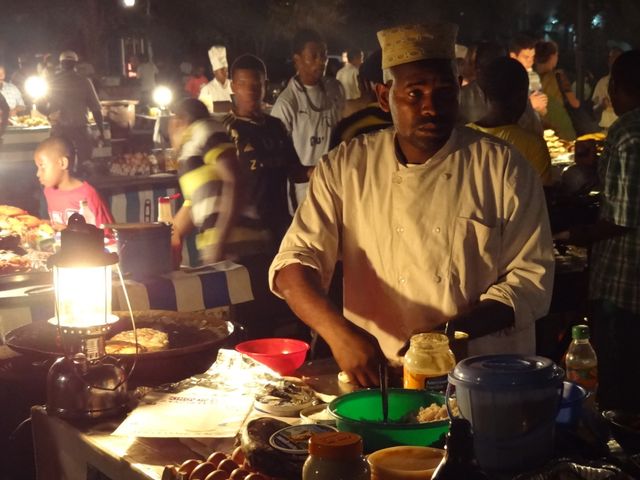
Forodhani Gardens is Stone Town's seafront street-food market, open each evening on the waterfront by the Old Fort. Vendors grill seafood and meat skewers, cook Zanzibar pizza to order, and press fresh sugarcane juice. Walking in is free; a light meal runs about US$3 to 8 (2026, verify). Order from the busiest stalls, eat what is cooked in front of you, and agree the price first.
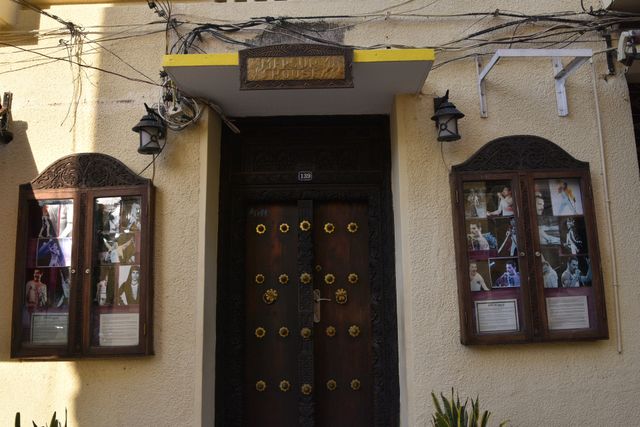
Freddie Mercury's house in Stone Town marks the Queen frontman's Zanzibar birthplace, now a small private museum on Kenyatta Road. Expect a handful of rooms of photos, record sleeves and his childhood story, not a big production. Entry is about US$10 for adults and US$6 for children (2026, verify); most people spend 20 to 30 minutes. Worth it for Queen fans, easy to skip if not.
Prison Island (Changuu) is a short boat ride from Stone Town, and the draw is its colony of giant Aldabra tortoises, some over a century old. Despite the name it never held slave-trade prisoners: a prison built here in 1893 was never used, and the island became a quarantine station. Entry is about US$12 to 15 per adult plus boat hire (2026, verify). A half-day trip, with snorkelling too.