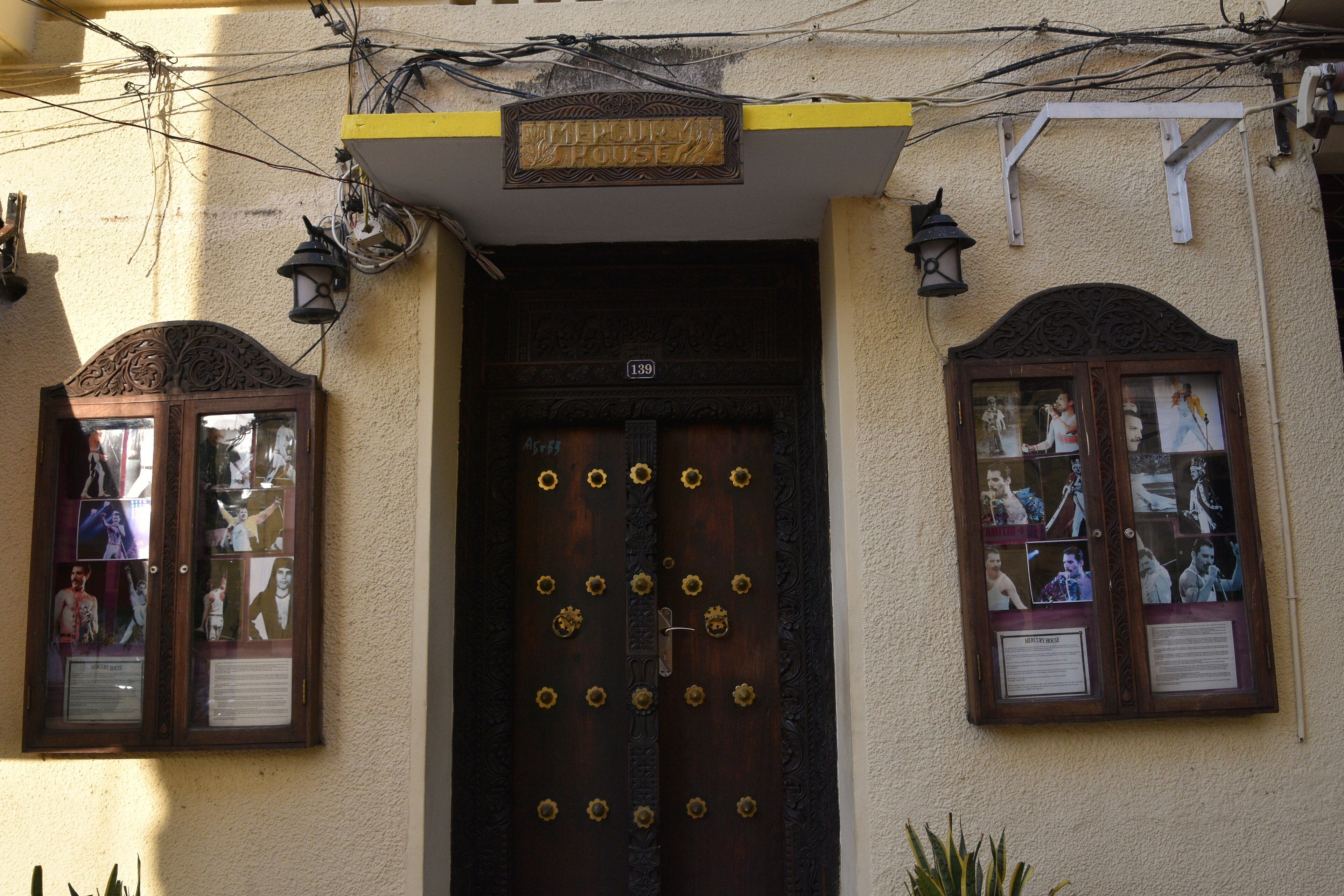
Freddie Mercury’s house in Stone Town marks the Queen frontman’s Zanzibar birthplace and is now a small private museum on Kenyatta Road. It tells the story of his island childhood through photos and memorabilia. Entry runs about US$10 for adults and US$6 for children (2026, verify), and most visitors need 20 to 30 minutes.
The pull is simple: one of rock’s biggest voices started life here, in a coral-stone town on the Indian Ocean, and standing on that street is a genuinely odd and lovely thing if you grew up on Queen. The museum itself is a handful of rooms in a private house, so come for the connection more than the collection.
Freddie Bulsara, the boy from Stone Town
He was born Farrokh Bulsara on 5 September 1946. His parents were Parsi, a Zoroastrian community with roots in India, and his father worked for the British colonial administration on the island. The family were part of Stone Town’s mixed Swahili, Arab, Indian and European world, the same blend you still read in the carved doors and the mosque-and-temple skyline today.
Young Farrokh spent chunks of his childhood in Zanzibar and was sent away to boarding school near Mumbai as a boy, which is where he first played piano in a school band. When political upheaval came to the islands in the early 1960s, around the 1964 revolution that ended the sultanate, the family left for England and settled near London. There the teenager became a musician, took the name Freddie Mercury, and by 1970 was fronting Queen. He died in 1991. He rarely spoke publicly about Zanzibar in later life, which is part of why the island connection surprises people, and it is the chapter this museum exists to tell.
One honest caveat. You will see the museum billed as his birthplace, and his birth in Stone Town in 1946 is beyond doubt, but the exact house is not settled. Sources point to more than one address linked to the Bulsara family, and the museum occupies a building tied to that story rather than a proven birth room. Treat the birthplace label loosely and enjoy the connection for what it is.
What’s actually inside
The museum sits in a restored Stone Town merchant house and opened in 2019. Inside is a compact set of rooms arranged as a walk through his life: family photographs, a timeline from Zanzibar to London, record sleeves, replica gold discs, panels about the Parsi community and old Zanzibar, and the odd stage costume image. There is usually a little shop and a spot to sit.
Go in knowing that most of what you see is reproductions and storytelling rather than a vault of original personal artefacts. You are not going to find his piano or his stage outfits behind glass. It is a well-meaning tribute assembled around a strong local story, and read that way it works. The panels do a decent job of placing him in the Zanzibar of the 1940s and 1950s, and the small thread on the island’s Parsi community, the Zoroastrian minority his family belonged to, is one of the more interesting corners, since most visitors have no idea Stone Town had one. That local context is more rewarding than another wall of concert posters, and it is the part first-time visitors tend to remember.
What it costs and how long you need
Entry is about US$10 for adults and US$6 for children in 2026 (verify at the door, as the price shifts and is sometimes quoted in Tanzanian shillings). Because it is privately run, there is no fixed government rate. Bring cash in small notes, US dollars or shillings, since card payment is patchy all over Stone Town.
Most people are done in 20 to 30 minutes, so treat it as a stop on a wider Stone Town wander rather than a destination on its own.
Before you go: a few practical tips
The museum generally opens daily, roughly 10:00 to 18:00, but it is small and privately run, so hours can wobble on quiet days and around Friday prayers. If it matters to your plan, check on the day rather than assuming. You do not need to book. Just walk up and pay at the door.
A handful of small things smooth the visit. Photography inside is usually fine, but ask before you start snapping. The building is an old Stone Town house with a step or two up from the lane, so it is not fully step-free, worth knowing if anyone in your group has mobility needs. Go late afternoon and you can walk straight out into the golden light on the seafront afterwards, which is the nicest time to be in Shangani anyway.
Is it worth it?
What's great
- A real, direct link to a global music icon, right where his story began
- Cheap and quick, easy to slot into a Stone Town walk
- The panels usefully set his childhood against 1940s and 1950s Zanzibar
- Friendly, low-key and rarely crowded
Keep in mind
- Small and modest; most displays are reproductions, not original artefacts
- Can feel steep for what you get if you are not a Queen fan
- The 'exact birthplace' claim is not settled
- Only 20 to 30 minutes of content, so not a destination on its own
The fair verdict: a lovely extra, not an essential. It rewards Queen fans and anyone tickled that Stone Town produced Freddie Mercury alongside its carved doors and spice trade. Keep it short and it is a happy little detour; come for a major museum and you will leave flat.
Finding it and building a Stone Town walk around it
The house is on Kenyatta Road in Shangani, the western corner of the old town near the waterfront hotels. It is signposted, and the big photos of Freddie by the door make it hard to miss. From the airport, a taxi into Stone Town is about US$10 to 15 (2026, verify), and from there everything in the old town is walkable.
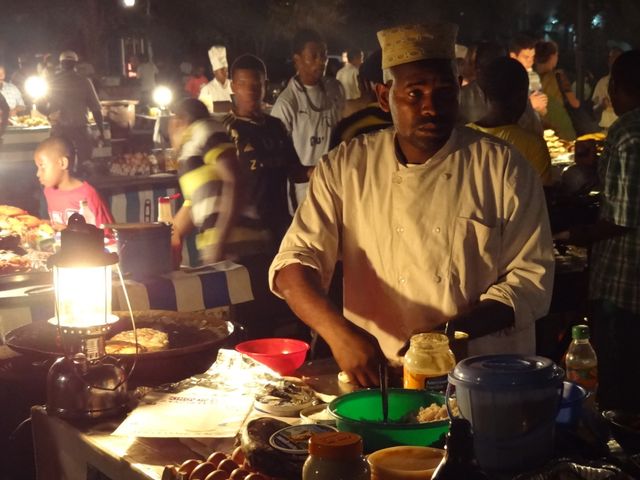
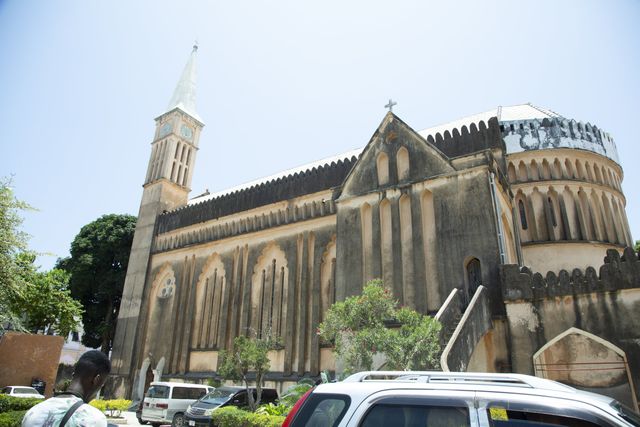
Because the visit is so short, treat it as one bead on a longer string. It is a few minutes on foot from Forodhani Gardens night market, so an easy plan is the museum in the late afternoon, then grilled food by the sea at dusk. For heavier history, walk over to the Old Slave Market and Anglican Cathedral, a sober and essential counterweight to the pop-culture stop. To see how it all fits together, start with the Stone Town visitor guide, which maps a walking route through the carved doors, markets and seafront in half a day or so.