
Zanzibar Packing List: What to Pack
The stuff you'll actually use: modest cover-ups, reef-safe sunscreen, the right plug, a dry bag, and clean dollars for tips.
A good Zanzibar packing list is shorter than you think. Pack light, breathable clothes with a few modest cover-ups for town, swimwear for the beach, reef-safe sunscreen, insect repellent, a dry bag for boat trips, and a UK type-G plug adapter. Add malaria tablets, clean US dollar notes for tips, and a local SIM or eSIM, and you have the essentials covered.
The island is hot, humid and casual, so most of your suitcase is beach and sun kit. The parts people forget are the ones tied to how Zanzibar actually works: a Muslim island where you cover up in town, a cash economy that is fussy about which dollar bills it accepts, big east-coast tides that reward reef shoes, and no working ride-hailing apps. Below is everything worth bringing, grouped by what it is for, with the local reasons behind each choice.
Clothes: light, modest, and beach-ready
Think natural fabrics and loose cuts. Cotton and linen breathe in the humidity where synthetics cling and sweat. You want a mix of two wardrobes in one bag: beach clothes and swimwear for the sand and resort, and modest cover-ups for Stone Town, the villages and the markets, where the custom is to cover your shoulders and knees.
For most travellers that means a few t-shirts and short-sleeved tops, a couple of loose dresses or shirts, lightweight trousers or a maxi skirt, and one or two swimsuits with a sarong or kaftan to throw over them. A light scarf or a locally bought kanga is the single most useful item on this list: shoulder cover in a cooler shop, a head cover if you visit a mosque, and shade on a hot walk. Evenings can carry a faint coastal breeze, so pack one light layer, a linen shirt or a thin cardigan. You will not need anything warm.
The dress rules matter more than on a typical beach trip, so it is worth getting them right rather than guessing. Our what to wear in Zanzibar guide covers the beach-versus-town line, Ramadan, and what is fine and what is not, in full.
Shoes for sand, reef, and Stone Town’s alleys
Three pairs cover almost everything. Flip-flops or slip-on sandals for the beach and resort. A comfortable pair of walking sandals or trainers for Stone Town, whose alleys are uneven coral-stone and not kind to flimsy soles. And a pair of reef or water shoes, which are the item most first-timers skip and later wish they had packed.
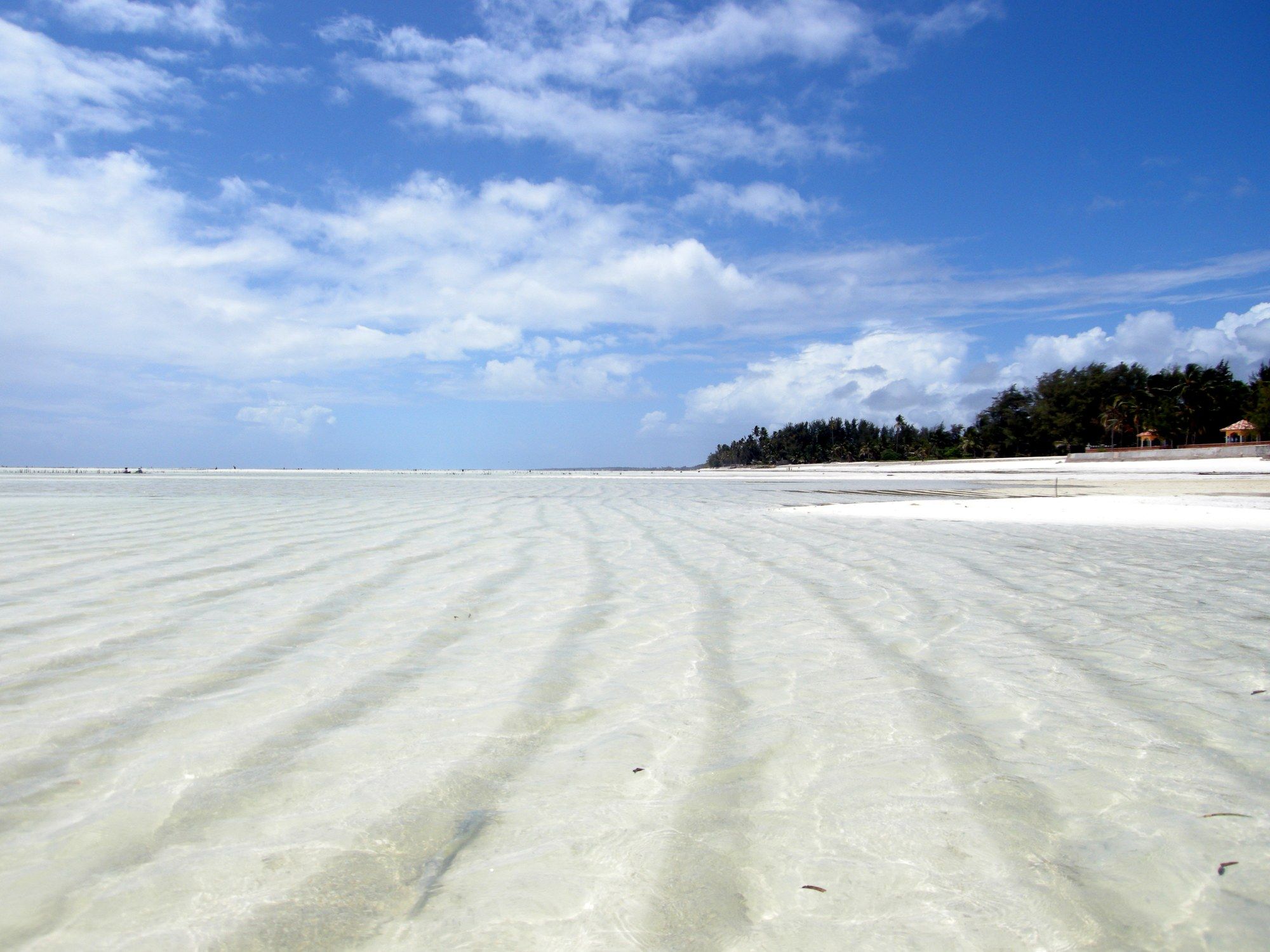
Here is why the reef shoes earn their space. On the east and southeast coast, from Paje down to Jambiani and up around Matemwe, the sea sits on a broad, shallow reef flat. At low tide the water withdraws hundreds of metres, sometimes close to a kilometre, exposing sharp coral, sea urchins and rocky reef. Walking that barefoot is a bad idea. Even at the swim-anytime north beaches around Nungwi, water shoes help on rocky entries and boat trips. If you are choosing a beach around the tide, our guide to the best time to visit Zanzibar explains how the coasts and tides differ through the day and year.
Sun and skin: reef-safe sunscreen and a proper hat
Zanzibar sits just south of the equator, and the sun is stronger than the sea breeze lets on. Bring a high-SPF sunscreen, 50 or above, and make it a reef-safe one: a mineral formula based on zinc oxide or titanium dioxide, without oxybenzone, which damages the coral you have come to snorkel over. Sunscreen is sold on the island but the choice is limited, so pack what you like from home.
Round out the sun kit with a wide-brim hat, polarised sunglasses, and a lip balm with SPF. A rash guard or long-sleeved swim top is smart if you burn easily or plan long snorkelling sessions over Mnemba or the house reefs. Reapply more often than you think; the water and the breeze hide how much sun you are catching.
Bugs and the medicine bag
Malaria is present year-round in Zanzibar, and health authorities recommend antimalarial tablets plus bite avoidance. That makes insect repellent a genuine essential, not an afterthought. Bring a repellent with DEET or picaridin, cover up at dusk with long sleeves and trousers, and use the mosquito net if your room has one. This is health advice to run past a travel clinic four to six weeks before you go, not a prescription, and the full picture lives in our Zanzibar health guide.
Pack your medicine bag with intent, because pharmacies are limited outside Stone Town and larger towns. Bring any prescription medicines in their original packaging with enough for the trip, your malaria tablets, and a small kit for the usual travel complaints: rehydration sachets, anti-diarrhoea tablets, painkillers, plasters, antihistamine, and motion-sickness tablets if boats do not agree with you. Add a hand sanitiser and a refillable water bottle, since you should not drink the tap water.
Plugs, power, and electronics
Zanzibar runs on 230 volts at 50 hertz, and the sockets are mostly the UK-style type-G three-pin. If you are coming from the UK or Ireland your plugs fit as they are. Everyone else needs an adapter, and a UK or universal one is the safe buy. A few older buildings still use the round-pin type-D socket, so a universal adapter with both saves any surprises. Most modern chargers accept the full 100 to 240 volt range, so you need an adapter rather than a heavy voltage converter, but glance at the label on your charger to be sure.
Power on the beaches can be less than constant, with the odd cut, so a power bank is worth its weight for keeping your phone alive through a long boat day. Bring a waterproof phone case or pouch, and a proper dry bag for anything you take on a dhow, a snorkelling trip or Safari Blue. Spray, spume and the occasional tropical downpour will find your camera and documents otherwise. A head torch or small flashlight is handy for unlit paths after dark.
Staying connected: SIM, eSIM, and the ride-hailing gap
Sort your data before you rely on it. A local SIM from one of the main Tanzanian networks is cheap and easy, bought at the airport or in Stone Town with your passport, or you can set up an eSIM on your phone before you fly and switch it on when you land. Either gives you data for maps, messaging and booking.
Connectivity matters more here than on most beach trips because of one thing visitors often assume wrongly: there is no reliable Uber or Bolt on Zanzibar. The big international ride-hailing apps do not operate dependably, and a local app exists but coverage is patchy. In practice you rely on hotel transfers and taxis where you agree the fare before setting off. Download an offline map of the island, save your hotel’s location and contact, and arrange your airport transfer in advance rather than expecting to summon a car from an app.
Money: cash, clean dollars, and tips
Zanzibar is a cash economy, so plan to carry more physical money than you would at home. The local currency is the Tanzanian shilling, but US dollars are widely accepted for hotels, tours and larger purchases. There is one rule that trips people up: US dollar notes must be Series 2009 or newer, and crisp and untorn. Old, worn or pre-2009 bills are routinely refused, so ask your bank for newer notes and carry a range of small denominations. ATMs exist in Stone Town, the airport and larger towns but can be unreliable, run out of cash, or charge fees, and cards are only taken at bigger hotels and restaurants, often with a surcharge.
Keep small notes handy for tipping, which is customary rather than required, so you always have change for a driver, a guide, or the person who carries your bags. The full breakdown of currency, cards, budgets and how much to tip is in our money and costs guide.
One piece of cover you cannot skip is the government inbound insurance, which every foreign visitor now needs to enter and which is separate from any travel policy you already hold.
For the passport rules, the Tanzania visa, and the detail on that mandatory ZIC insurance, see our Zanzibar visa and entry guide. Carry your passport with at least six months of validity, print or save a copy of your bookings, and keep a photo of your documents in your phone and the cloud.
Pack for the season
Zanzibar is warm all year, so this is a fine-tuning step rather than a rethink. From June to October, the cooler, breezier Kusi season, add that extra light layer for the evenings and expect wind on the east coast. From December to April it is hotter and more humid, so lean harder on the lightest fabrics and the sun kit. If you are travelling in the long rains from about March to May, pack a compact rain jacket or poncho and quick-dry clothes; the showers are heavy but usually short. Our best time to visit guide breaks down the weather month by month if you want to match your bag to your dates.
Bags, and the case for packing light
What you carry it all in matters more than it seems. A soft holdall or a wheeled bag with some give travels better than a rigid hard-shell over sand, boat decks and the occasional dala-dala, and it is essential if a small bush flight to a safari or Pemba is on your itinerary. Add a packable daypack for excursions, spice tours and day trips, and a simple beach bag you do not mind getting sandy.
Then pack less than you planned. Zanzibar is hot and casual, you will rotate the same few favourite pieces, and most guesthouses and hotels offer cheap same-day laundry, so a week’s clothes stretch to two easily. Packing cubes keep the beach half and the town half of your wardrobe sorted, and leaving a little space means room for a kanga or two on the way home.
The quick Zanzibar packing checklist
Everything above, stripped to a list you can pack against:
- Light cotton and linen clothes; modest cover-ups for town (shoulders and knees)
- Swimwear plus a sarong, kaftan or dress to cover up
- A light scarf or kanga (shade, mosques, cooler shops)
- One light layer for breezy evenings
- Flip-flops, walking sandals or trainers, and reef or water shoes
- Reef-safe SPF 50+, wide-brim hat, polarised sunglasses, SPF lip balm
- Insect repellent with DEET or picaridin
- Malaria tablets and any prescription meds, in original packaging
- Small travel medical kit and hand sanitiser
- UK type-G plug adapter (universal covers the odd type-D socket), power bank
- Dry bag and a waterproof phone case
- Head torch, refillable water bottle, small daypack
- US dollars in clean Series 2009+ notes, small denominations, plus a card
- Passport (6 months validity), copies of bookings, travel insurance details
- Sorted data: a local SIM or eSIM, and an offline map downloaded
What to leave at home
A few things are more hassle than help. Skip plastic carrier bags: Tanzania bans single-use plastic bags, and they can be taken off you on arrival, so bring a reusable tote instead. Clear ziplock toiletry bags are the one exception and are allowed, so those are fine to pack. Leave heavy jumpers and jeans; you will not use them and they take up space and dry slowly. Camouflage-pattern clothing is best avoided in this part of the world, as it is associated with the military and can draw questions. If your trip pairs Zanzibar with a mainland safari on small bush flights, check your baggage allowance early, as those flights often cap you at around 15 kilograms in a soft bag, so a hard-shell suitcase can be a problem. And do not over-pack toiletries you can buy on arrival; a modest bag beats lugging a full bathroom across the island.
Get the essentials right, keep it light, and Zanzibar rewards you for travelling simply. The heat, the salt water and the relaxed pace mean you will live in a handful of favourite pieces anyway.
Frequently asked questions
What should I pack for Zanzibar?
Light, breathable clothes plus modest cover-ups for town, swimwear for the beach, reef-safe sunscreen, a wide-brim hat and sunglasses, insect repellent, malaria tablets and any prescription meds, a dry bag for boat trips, a UK type-G plug adapter, and clean US dollar cash in small notes for tips. A local SIM or eSIM is worth sorting too, since there is no reliable Uber or Bolt on the island.
What plug adapter does Zanzibar use?
Zanzibar runs on 230V, 50Hz and uses mainly the UK-style type-G three-pin plug, so a UK adapter works almost everywhere. A small number of older buildings still have type-D round-pin sockets, so a universal adapter covers you fully. Most phone and laptop chargers handle 100 to 240V, meaning you need an adapter, not a voltage converter, but check the label on yours first.
Should I get a local SIM in Zanzibar?
It is well worth it. A local SIM from one of the main networks, or an eSIM you set up before you fly, gives you cheap data for maps and messaging. This matters more than usual in Zanzibar because there is no reliable Uber or Bolt, so you lean on hotel transfers and negotiated taxis, and data helps you check routes and stay in touch. You can buy a local SIM at the airport or in Stone Town with your passport.