
Jozani Forest: Red Colobus Monkeys & Practical Guide
Jozani Forest is Zanzibar's only national park and the one place on Earth to see the endemic red colobus monkey. Entry is about US$10 to 12 per adult (2026, verify), a park ranger is included, and a guided visit takes one to two hours across a forest loop and a mangrove boardwalk. It sits in the centre-south of Unguja, on the main road to the east coast beaches.
Jozani Forest is Zanzibar’s only national park and the one place on Earth you can see the endemic Zanzibar red colobus monkey. Entry runs about US$10 to 12 per adult (2026, verify), a park ranger guides you, and you need roughly one to two hours. The gate opens around 07:30; arrive by 08:30 for the liveliest monkeys.
It is an easy, cheap, low-drama stop, which is exactly why it works. You do not need to be a wildlife obsessive to enjoy an hour among habituated monkeys and a boardwalk over a mangrove creek, and because Jozani sits on the main road south, it slots into a beach transfer or a spice-farm morning without eating a whole day.
Jozani at a glance
- What it is: Zanzibar’s only national park (part of Jozani Chwaka Bay), a protected groundwater forest in the centre-south of Unguja.
- The draw: the Zanzibar red colobus monkey, found nowhere else, plus a raised mangrove boardwalk.
- Entry: about US$10 to 12 per adult, ranger-guide included (2026, verify); children pay less.
- Hours: roughly 07:30 to 17:00 daily (last entry about 16:00); come by 08:30 for active monkeys.
- Time needed: one to two hours.
- Getting there: about 35 km and 45 minutes from Stone Town, on the road to Paje and the southeast coast.
The red colobus, Zanzibar’s only endemic primate
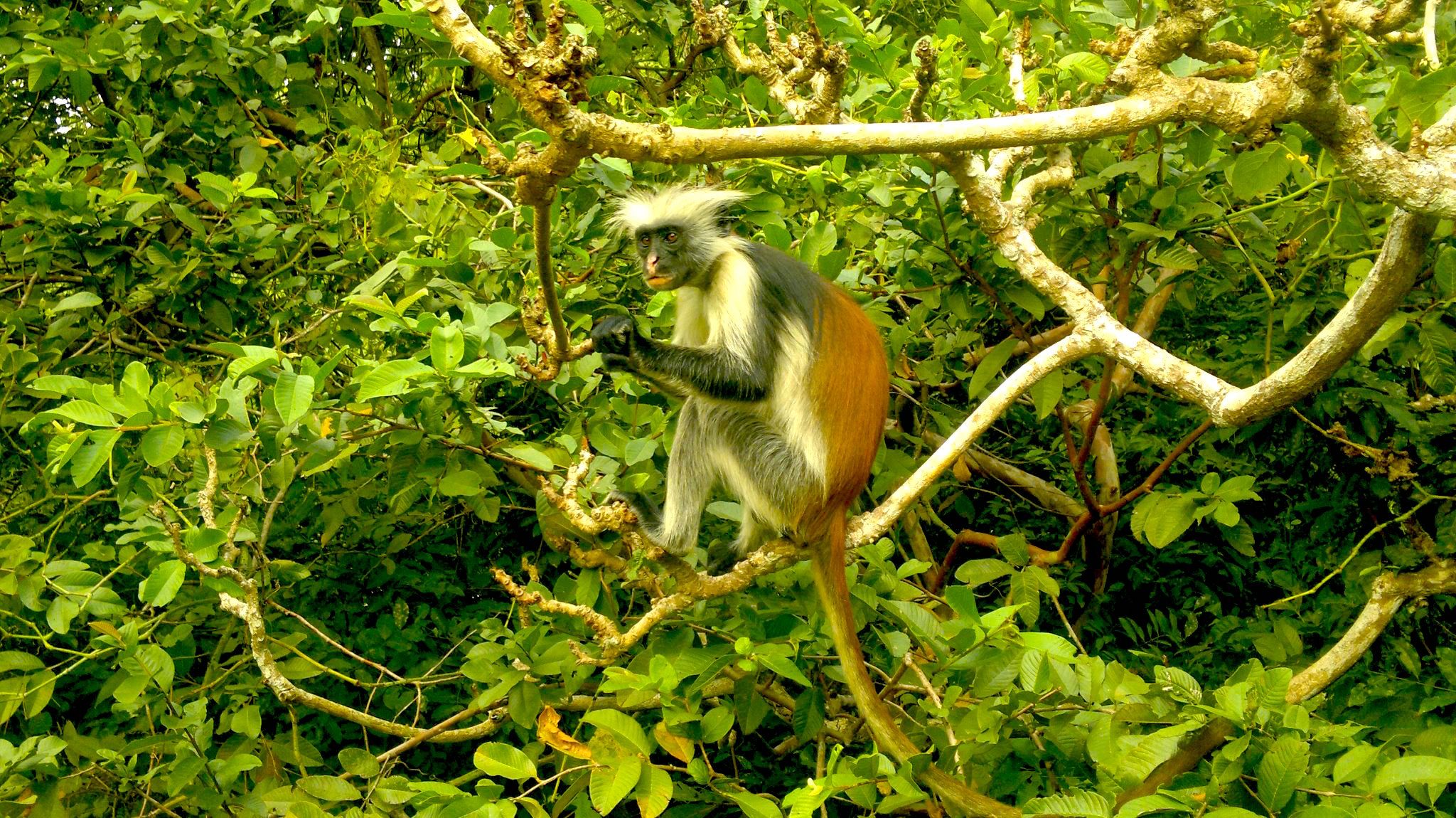
The Zanzibar red colobus lives here and nowhere else. It has a rust-red back, a dark face ringed with pale fur, and a habit of lounging in the low branches right beside the trail. Most of the world’s surviving population lives in and around this forest, which is why the park exists and why the monkey became the flagship for conservation across the islands from the 1990s.
What surprises most people is how close you get. The troops near the visitor trail are used to a steady trickle of humans, so instead of a distant glimpse through binoculars you often stand a few metres from monkeys grooming, feeding on young leaves, and carrying babies. It photographs well even on a phone.
What it costs, and why you cannot go in alone
Entry is about US$10 to 12 per adult in 2026 (verify the current gate price, as park fees are raised from time to time), with a lower rate for children. The important part: the fee includes a park ranger, and you cannot walk the monkey trail without one.
That guiding rule is not a money-grab. The rangers know which troops are near the path that day, so you actually find the animals, and keeping visitors on guided routes protects the forest and the colobus. For the standard walk you do not need to book ahead. Turn up during opening hours, pay at the gate, and join a ranger. A small tip at the end is customary and appreciated.
If you would rather not arrange your own transport, most hotels and operators sell a Jozani half-day with pickup, drop-off and the guide bundled together, usually around US$20 to 40 per person depending on group size (2026, verify). That is the easy option if you are staying on a far beach without a car.
The two walks: forest loop and mangrove boardwalk
A visit comes in two parts. First is the guided forest loop, a flat, shaded trail through tall groundwater forest where the red colobus troops hang out. This is the monkey part, and it takes roughly 45 minutes to an hour.
Second is the mangrove boardwalk, a short drive or hop from the main trail, where a raised wooden walkway carries you out over a tidal creek and through the mangroves. It is calm, a bit otherworldly at high water, and a good contrast to the forest. Along the way your guide will point out chameleons, butterflies, medicinal plants and, if you are lucky and quiet, other small forest life. Bush babies live here too, but they are nocturnal, so daytime sightings are uncommon.
Wear closed shoes you do not mind getting muddy, especially in the long rains from March to May when the forest floor stays wet. Bring water and insect repellent.
How long you need and when to go
Budget one to two hours for the whole visit, which is enough to see the monkeys and walk the boardwalk without hurrying. Morning is clearly best. The colobus feed most actively in the cooler early hours, and arriving by about 08:30 puts you ahead of the tour groups that roll in from mid-morning.
Jozani is open year-round. The forest is at its greenest in and just after the rains, though the trails are muddier then; the dry season from June to October gives firmer footing. For how the seasons stack up across the island, see our best time to visit guide.
Getting to Jozani
The park sits in the centre-south of Unguja, about 35 km and 45 minutes from Stone Town on the main tarmac road that runs down to Paje and the southeast beaches. That location is its practical superpower: it is more or less on the way if you are transferring between Stone Town and the east coast, so it costs you almost no extra driving.
Getting there is simple. Take a taxi (agree the fare first), drive a hired car or scooter, or book the half-day tour with transport included. Many visitors pair Jozani with a spice farm tour in the morning or tack it onto the drive to a beach at Paje or Jambiani, turning a transfer day into a proper outing. For where it fits among the island’s other trips, see the full list of things to do in Zanzibar.
Is Jozani Forest worth it?
What's great
- Cheap and easy: a short guided walk with close-up, habituated monkeys
- The red colobus is unique to Zanzibar, so this is your only chance to see it
- On the main road south, so it slots into a beach transfer or a spice-farm morning
- Good with kids, and the mangrove boardwalk adds variety
Keep in mind
- A gentle nature walk, not a big-game safari; set expectations
- You cannot self-guide the monkey trail, a ranger is required
- Gets busy with tour groups from mid-morning
- Trails turn muddy in the long rains, March to May
Yes, with your expectations set right. This is a gentle, guided nature walk, not a big-game safari, and the pleasure is in how easy and close it is: a cheap ticket, a shaded hour with monkeys that all but pose for you, and a quiet boardwalk over the mangroves. Families with kids tend to love it, and it is one of the few Zanzibar outings that is genuinely low-effort.
Go in expecting a stroll rather than a spectacle, come early, and it is well worth the couple of hours. Your fee also goes toward protecting a species that has nowhere else to live, which makes the stop feel like more than a box ticked.
Where it is
Frequently asked questions
How much does it cost to visit Jozani Forest?
Entry is about US$10 to 12 per adult in 2026 (verify before you go, as park fees change), and children pay less. The ticket includes a park ranger who guides you through the forest, so you do not pay a separate guide fee, though a small tip at the end is normal. If you book a tour that includes hotel pickup and transport, expect to pay more, roughly US$20 to 40 per person depending on the operator and group size.
Can you visit Jozani Forest by yourself?
You can drive or taxi to the park on your own, but you cannot walk the monkey trail alone. A park ranger has to guide you, and that guide is included in the entrance fee. This is partly to protect the endangered red colobus and partly so you actually find the animals, since the rangers know which troops are near the path that morning. You do not need to pre-book for the standard walk; you can turn up during opening hours and join a guide at the gate.
How long do you need at Jozani?
Plan for one to two hours. The guided forest loop where you see the red colobus takes about 45 minutes to an hour at an easy pace, and the mangrove boardwalk across the tidal creek adds another 20 to 30 minutes. That is enough to see the highlights without rushing. It fits neatly into a half day, which is why many people combine it with a beach or a spice farm on the same trip.
What can you see at Jozani Forest?
The headline is the Zanzibar red colobus monkey, a rust-and-black primate found nowhere else in the world, and the troops here are used to people, so you often watch them feed a few metres away. You may also see Sykes' monkeys, tiny bush babies (mostly nocturnal, so daytime sightings are rare), chameleons, butterflies and plenty of birds. The second half of a visit is the raised mangrove boardwalk, which winds over a tidal creek and is worth the short extra walk.
What time does Jozani Forest open?
The park generally opens around 07:30 and closes around 17:00, with last entry about 16:00, though hours can shift, so check locally or with your tour operator before setting out (2026, verify). Aim to arrive by about 08:30. The red colobus are most active feeding in the cooler morning, and you also beat the tour-bus crowds that build from mid-morning.